I wanted to share a bit of a spinning “yarn” (story) with you.
 |
The sheep roving coming onto the spinning wheel
and loading onto the bobbin. |
Winter is my season for spinning and
quilting. All summer long I am outside
working on the farm every available moment. Fields to mow, jams to make, fields
to mow, pickles to make, fields to mow, gardens to weed, fields to mow, fences
to paint, fields to mow…..you get the message!
 |
Lazy Kate with bobbins.
Middle one is new, the other two are left over from previous plying.
(Note various thicknesses)
When I add another full bobbin, I will ply them.
Holds bobbins for 2-ply or 3-ply yarns. |
But, during the winter, with its
shorter days, I find myself able to get caught up with many inside projects while
my fields “hibernate”. So, now instead of the noise of my mower, I get to listen
to the whorl of the spinning wheel, the beating of the loom, and the hum of my
sewing machine. Maybe I ought to wear
earplugs in the winter, too! J
 |
Light Brown, Grey, Brown- Llama
Whites- Sheep
Note the comparison of thicknesses between light brown and dark brown. |
I recently evaluated my wool “stash”, and realized I had a
problem. I have POUNDS of wool that I have to do SOMETHING with before spring
and the next shearing! So, I began hauling out the bags of clean and processed
wool, and put them in the spinning room.
I suddenly felt like the miller’s daughter with a huge spinning task
ahead of me!
 |
Icelandic Sheep
Note comparison of thicknesses.
This is an example of "spinning for the project you are making"
These were NOT used for same project. |
So, I decided to mark each bag of wool with the project I
wanted it to be used for. Now I have
bags for spinning, felting, weaving.
Problem is: I still have POUNDS
of wool that I have to do SOMETHING with before spring and the next shearing!!
 |
Lt. Brown- llama
White- Icelandic Sheep
Note the comparison of thicknesses.
All are excellent for what they will be used for.
I use the light brown for the string hanger
on my felted Christmas ornaments. |
I am going to take one large bag of wool and use it as
batting for a quilt that I’ve recently finished piecing the top together. The
batting will be between the top and bottom and then I will quilt the whole
thing. Wool is excellent as batting,
because it breathes. So it is cool in
the summer, cozy in the winter, and if that’s not enough, it’s flame retardant
as a bonus!
 |
Batting being made for the quilt.
There is nothing quite like the feel and comfort of a wool batt quilt. |
Well, that’s one bag down…..good! But, I still have POUNDS
of wool…… (Say it with me this time!)….that I have to do SOMETHING with before
spring and the next shearing!
 |
Black on the left is adult llama.
Black on the right is Shetland sheep lamb fleece.
I spun the llama very thinly for one project and
spun the sheep average to thick for another project.
Of each yarn, I had spun over 300 yds. |
So, I’ve begun to spin, and SPIN, and SPIN and SPIN!
My fingers needed a break, so I decided to type my blog instead! J (ouch!)
 |
Scarf knitted from spun Icelandic lamb fleece.
Incredibly pristine, warm, and comforting! |
I shouldn’t complain.
I really do love all that I’ve made in the last few weeks. I’ve made a few quilt tops, several skeins of
yarn, and I about to start an interesting project on the loom (wimpy, but
interesting).
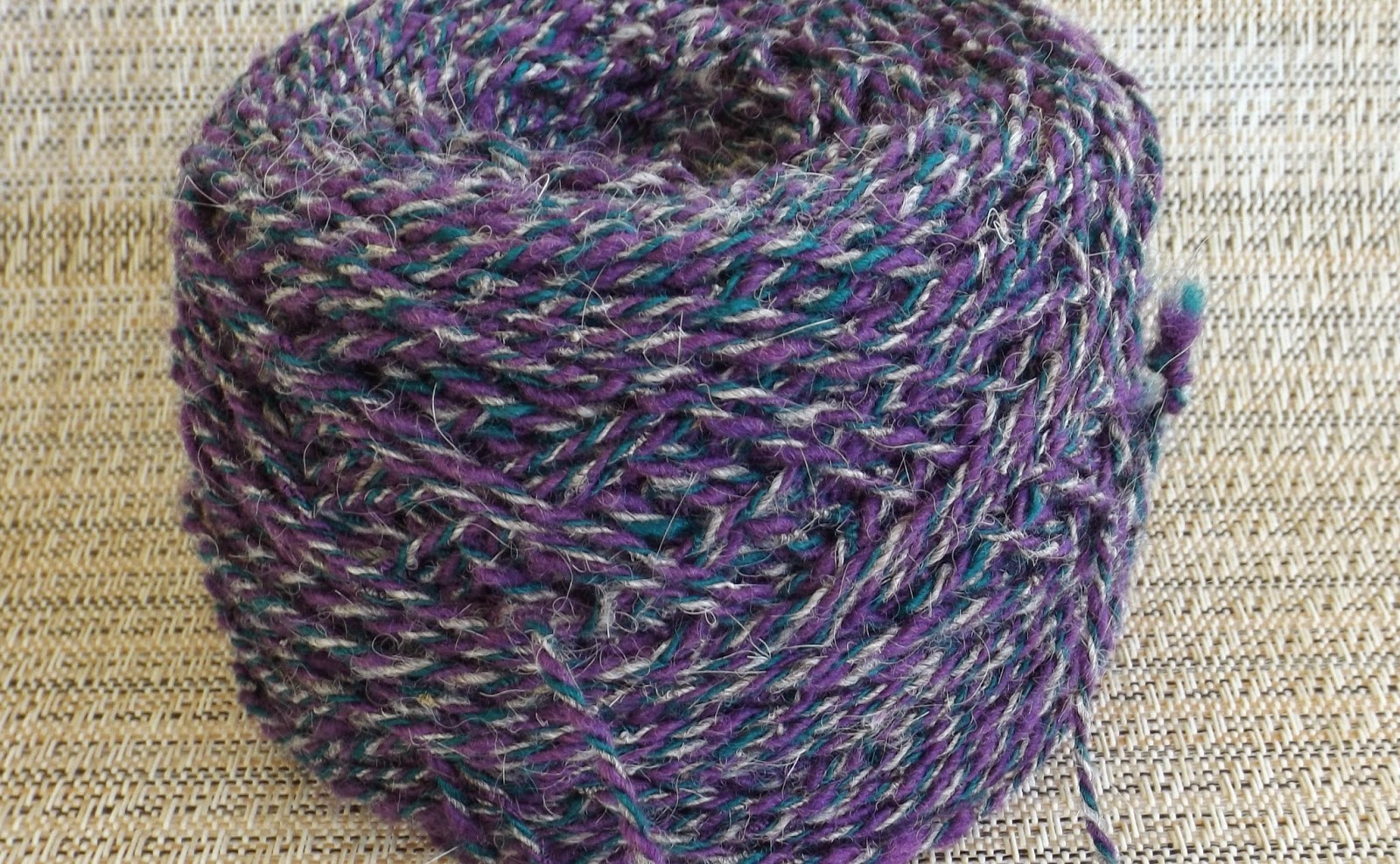 |
Tri-colored yarn. (3-ply)
Used white (llama), dark teal (alpaca), and purple (sheep), all of which I'd spun
very, very thinly. Not a lot of crimp because of llama and alpaca, but very soft. |
I still get plenty of outside time….there is morning and
evening feedings on the farm, plus water troughs to fill, paddocks to muck, and
believe it or not…..I mowed earlier this week! CRAZY! Even crazier is the fact
that the Clematis is blooming again, as well as Hydrangea, Weigela, and a few
dandylions. Plus, the Dahlias and Cannas
haven’t stopped! I am counting each day like this past week as a reprieve from
the winter forecast that I am dreading.
 |
Dahlias just keep blooming.
So pretty to see each day.....! |
Spinning is fairly simple. For one thing, even if you don’t
spin well, the yarn should be able to be used for something! But, to make it easier and more enjoyable for
you, start with good wool. Half the battle should NOT be trying to make
something lovely out of a “difficult to spin” wool or fiber.
 |
First attempt at spinning.
It was llama fiber and is incredibly soft!
There is some variance in size of yarn throughout,
by no means perfect. |
I learned on llama
and alpaca fiber. I found it to be SO much simpler than some wool that I'd been originally given. The yarn that I spun as my first
project is fairly uniform (by beginner's standard only) and I attribute that to the fact that the fiber was
easy to work with. I remember learning to gauge my drafting (pulling the wool)
differently when I began to spin sheep wool.
I still enjoy both and would not pick one over the other.
 |
Spinning Wheel with a few bags
of clean wool waiting to be spun. |
I will say that I used to overspin (making it
too tight, not as soft as it could be). A friend who is a very talented spinner
and knitter would critique my work and send me back to the spinning wheel to
fix it. L
 |
Yarn beginning to go on bobbin.
The color underneath is the lead thread.
You can see the drive band coming up to meet the whorl. |
But, I will say that I learned and am happy
with that. There’s always something to
learn and I am nowhere near where I’d like to be talent-wise, but for the time
that I can spend on it, I’m content with my skill level (for now).
 |
Red and Green 2-ply yarn that I'd spun for a Christmas project - 2006
Made knitted table mats (wished they'd been woven).
Definitely NOT fancy, but it was my first attempt at
completing a project with yarn that I'd spun. |
I will share the projects that I do this winter on other posts.


